
A personalized book about screen dependency, written for your child
The episode has ended, but putting down the screen is difficult. You need a next step that fits your everyday life.
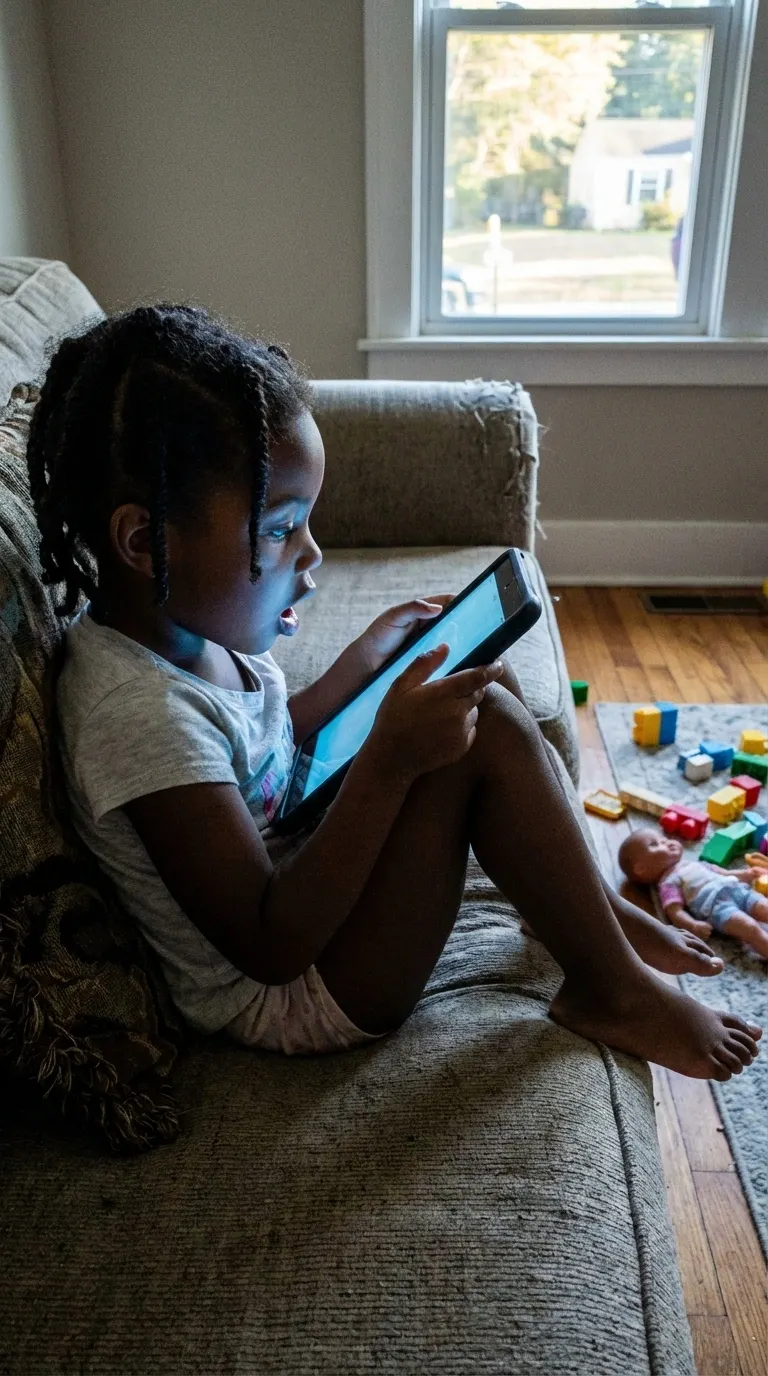
Moments you might recognize
- You handed over the tablet to finish a call. Now the call is over and the next episode has started. Putting it away is harder than you expected.
- The blocks are on the floor, but your child asks for the screen again. You are trying to find an ordinary next activity, with dinner still to make.
- You and your partner set different stopping points. Your child asks which rule applies tonight, and you realize you need to agree first.
Possible contexts and ideas to explore, in the free parent guide: Why does my child melt down when the tablet turns off?
When turning it off brings tears
The ending may interrupt a story or game before your child feels finished. That does not remove your responsibility to set a limit.
When possible, choose the ending in advance and disable automatic continuation. Stay with the disappointment without needing to make the next activity win a competition.
When screens make a busy day possible
A device may give you time for work, cooking or another child. A realistic plan begins with those constraints.
Try one repeatable change in the busiest part of the day. An available book or simple activity can be an option, without assuming your child will use it independently whenever you need.
When adults have different screen rules
Different expectations can make the ending unclear. It can also leave adults feeling that each difficult moment is somebody else’s fault.
Agree on one routine you can both explain. Review it together away from the handover, using what you observe rather than making the child choose between adults.
Ideas to explore at home
- Choose the ending before starting
- Show what comes next
- Keep the limit and allow disappointment
- Look at the routine as a whole
Find the context for each possibility in the guide: Why does my child melt down when the tablet turns off?
An Ownway Stories adventure to read together
Ownway Stories creates an adventure around screen dependency, with a character you choose carrying your child’s name. In a familiar paper-cut world, the hero discovers a possible next action with support available. The guide inside connects that particular story to ideas you can explore together. You choose what fits your family.
$32.99
A 32-page printed picture book, for ages 3–6 · You’ll see the cover and the first scenes before you decide.
Questions parents ask
Can a printed book really compete with a tablet?
A printed Ownway story offers a different shared activity, built around the difficulty of leaving something absorbing. The hero’s discovery can become a reference you explore together. The book is not a screen-use treatment or a guarantee of a quiet handover.
Are the story and the illustrations created for my child?
Yes. The story and illustrations are generated around the name, character, challenge, dedication, and short detail you choose. The system does not select a finished story from a fixed library.
What age is this for?
Ownway Stories are written for children ages 3 to 6 — the age when big feelings arrive faster than the words to describe them.
How long does delivery take?
Each book is printed on demand, so timing depends on production and the carrier. We currently ship within the US only and email available tracking details after dispatch.
Parents also work on
Facing something else? See all 16 challenges · Prefer to read first? Browse the free parent guides.