
A personalized book about attention seeking, written for your child
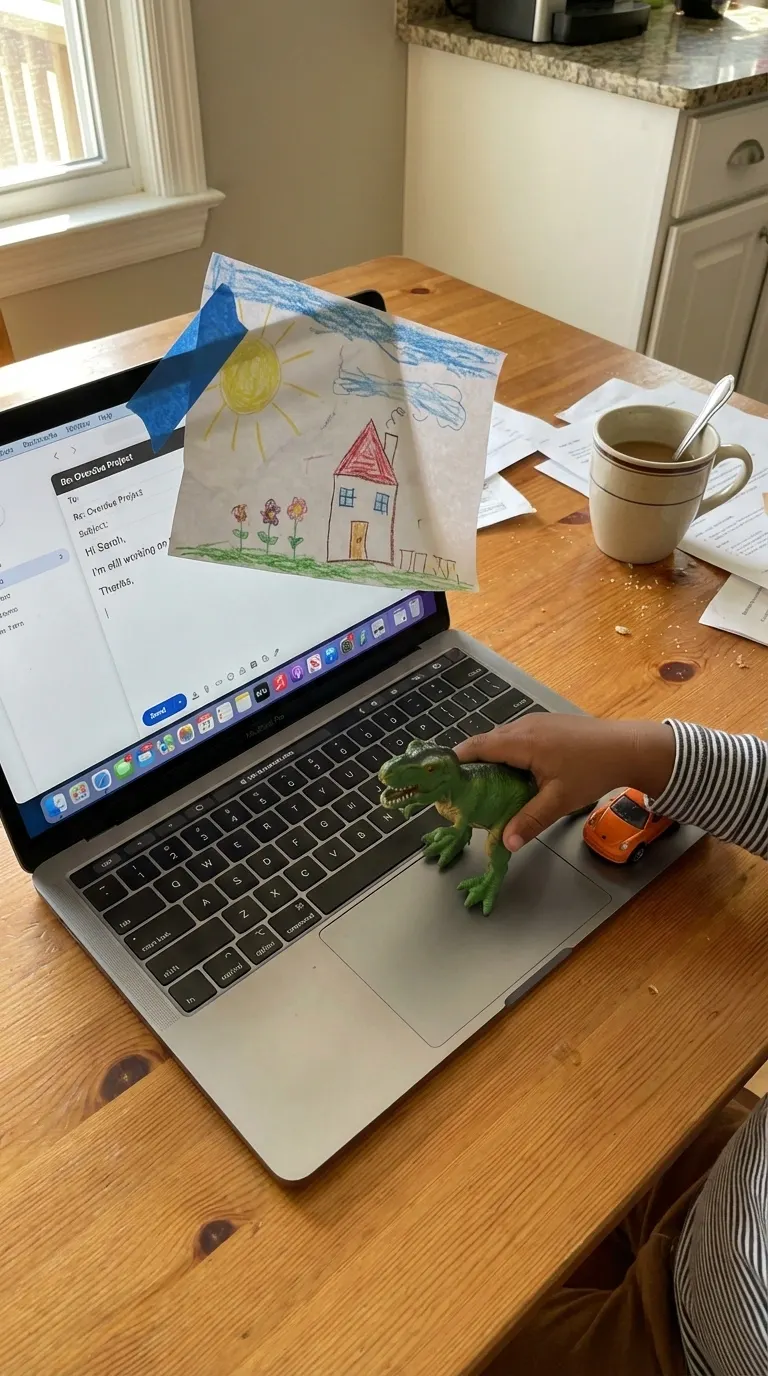
A toy on the keyboard. A hand on your sleeve. Your child wants you close while you are trying to finish one ordinary thing.
Moments you might recognize
- You sit down to answer an email. “Look.” A dinosaur appears on the keyboard. You want to see what they made and finish the sentence you started.
- You begin a phone call and your child brings a toy that needs fixing. You hold up a finger, but they do not know how long “one moment” will be.
- You close the bathroom door. A voice asks when you are coming out. You would like a little privacy without making your child’s wish for company feel wrong.
Possible contexts and ideas to explore, in the free parent guide: Why does my child need attention every single second?
When every phone call brings an interruption
You can see the purpose and endpoint of a call; your child may see only that you are suddenly unavailable.
Explain the next shared moment before the call when possible. Choose something you can keep, and offer help with what they can do while waiting.
When you cannot finish a sentence
Waiting for a conversational turn is something you can practice in a small ordinary moment. An exhausted busy day may not be the easiest starting point.
Agree on a signal and make the first waits manageable. Keep room for an urgent need, and do not require flawless waiting before your child is noticed.
When an interruption becomes unsafe
A wish for attention does not make hitting or breaking something acceptable. You can stop the action without withdrawing care.
Return later to what your child wanted and one other way to ask. A scene from their book may help start that conversation if the connection fits; it should not be used as evidence against them.
Ideas to explore at home
- Make a return you can keep
- Practice an ordinary way to interrupt
- Offer a small shared moment
- Keep unsafe actions separate from the need
Find the context for each possibility in the guide: Why does my child need attention every single second?
An Ownway Stories adventure to read together
Ownway Stories creates an adventure around attention seeking, with a character you choose carrying your child’s name. In a familiar paper-cut world, the hero discovers a possible next action with support available. The guide inside connects that particular story to ideas you can explore together. You choose what fits your family.
$32.99
A 32-page printed picture book, for ages 3–6 · You’ll see the cover and the first scenes before you decide.
Questions parents ask
How does a personalized book help here?
A personalized book is something you can read together, with your child’s name in an adventure. The story and its guide can explore finding a way to be heard. The purchase is not proof of your love, and no book replaces ordinary attention or support.
Are the story and the illustrations created for my child?
Yes. The story and illustrations are generated around the name, character, challenge, dedication, and short detail you choose. The system does not select a finished story from a fixed library.
What age is this for?
Ownway Stories are written for children ages 3 to 6 — the age when big feelings arrive faster than the words to describe them.
How long does delivery take?
Each book is printed on demand, so timing depends on production and the carrier. We currently ship within the US only and email available tracking details after dispatch.
Parents also work on
Facing something else? See all 16 challenges · Prefer to read first? Browse the free parent guides.